
Health Care
Building Health, Restoring Trust
JGR’s 5-Point Plan to Rebuild from COVID-19 and Never Be Left Vulnerable Again
COVID-19 was not an equal-opportunity disaster. It hit hardest where health care access was weakest, housing was most crowded, and government investment had been neglected for decades. Nowhere was that clearer than in East Elmhurst and Corona, which became national symbols of loss. Yet, they remain dangerously under-resourced today.
COVID-19 was not just a public health emergency. It was a moral reckoning. In New York City, Black and Brown neighborhoods were asked to carry the greatest burden of the pandemic while receiving the least protection. East Elmhurst, Corona, and Jackson Heights, home to working-class Black, Latino, and immigrant families became ground zero for loss.
COVID-19 did not just expose a virus. It exposed deep inequities in access to health care across East Elmhurst, Corona, and Jackson Heights. Too many families lost loved ones not because help wasn’t possible, but because it wasn’t available. As someone who lived through this crisis alongside my neighbors, I believe recovery means rebuilding trust, infrastructure, and leadership together.
Six years later, the most painful truth is this: the systems that failed these communities have barely changed. That is unacceptable and it demands a different kind of leadership.
1. Build a Full-Scale Primary Care Clinic in East Elmhurst; A Black Community Still Waiting for Investment
East Elmhurst is a historic Black neighborhood, home to generations of African American, Caribbean, and immigrant families. It suffered one of the highest COVID death rates in the world. During the first wave of the pandemic, mortality rates in East Elmhurst ZIP codes were more than twice the citywide average, driven by preexisting health inequities, overcrowded homes, and limited access to preventative care.
This devastation was not inevitable. It was the result of decades of disinvestment in Black communities. The absence of nearby primary care clinics meant residents were more likely to delay care, rely on emergency rooms, or go untreated altogether. COVID did not create these conditions; it exposed them in the most brutal way possible.
Six years later, East Elmhurst still does not have a full-scale, state-supported primary care clinic. That is a failure of priorities. I will fight to secure state capital funding for a comprehensive community health clinic in East Elmhurst, offering primary care, urgent care, maternal health, mental health, and preventative services. Black communities deserve permanent health infrastructure, not temporary crisis response.
2. Expand Care in Corona - A Latino and Immigrant Community Hit Hardest
Corona became one of the deadliest COVID hotspots in the entire nation. Predominantly Latino and immigrant, the neighborhood experienced death rates that exceeded nearly every other ZIP code in New York City, New York State, and the nation. Families lost parents, grandparents, and breadwinners, often while working essential jobs that kept the city running.
Language barriers, fear around immigration status, lack of insurance, and overcrowded homes made accessing care even harder. Clinics were overwhelmed. Emergency rooms became the default. Mental health needs skyrocketed and still remain largely unmet today.
Despite all of this, access to primary care in Corona remains stretched thin. I will fight to expand clinic capacity, open satellite locations, extend hours, and ensure culturally competent, bilingual care. Recovery means recognizing that Latino and immigrant communities were hit hardest and directing resources accordingly.
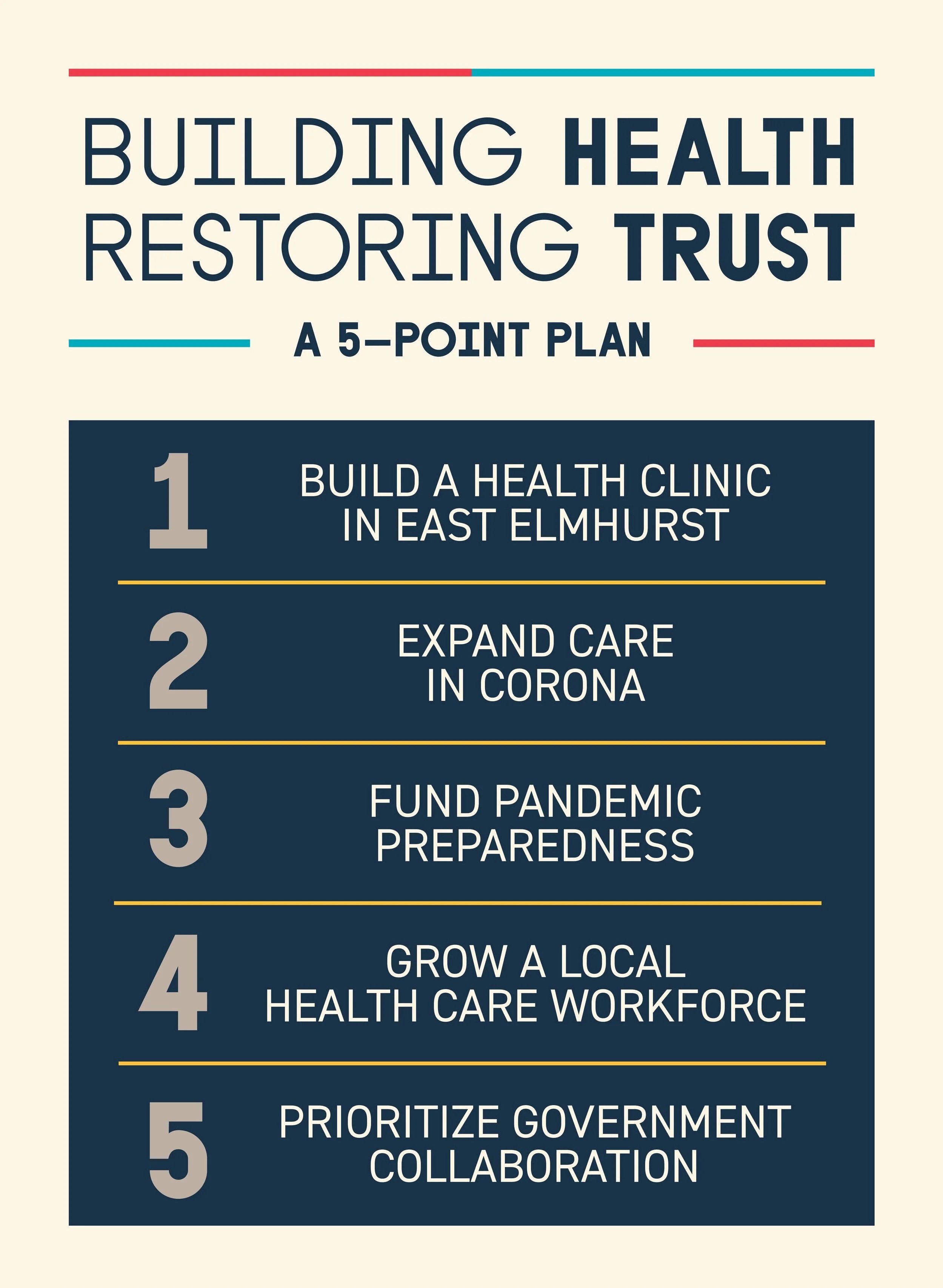
3. Lock In Permanent Pandemic Preparedness at the Local Level
COVID revealed a devastating truth: when the crisis hit, our neighborhoods were on their own. PPE was scarce. Testing was delayed. Information was inconsistent. Community-based organizations stepped up but without the resources or coordination they needed.
East Elmhurst and Corona experienced hospitalization and death rates far above city and state averages, yet were among the last to receive testing sites, mobile care units, and sustained public health outreach. That delay cost lives. Preparedness cannot be reactive. It must be built into the system.
I will push for permanent state funding to establish neighborhood-based emergency health hubs, stockpiled PPE, rapid testing capacity, and mobile clinics ready to deploy in future crises. Public health infrastructure should be strongest where the risk is greatest; not weakest where the need is clearest.
4. Grow a Local Health Care Workforce Rooted in the Community
COVID also exposed a staffing crisis. Hospitals and clinics serving East Elmhurst, Corona, and Jackson Heights were overwhelmed, even as residents of these same neighborhoods worked as essential workers on the frontlines often without adequate protection or pay.
We missed a major opportunity to turn recovery into economic empowerment. Six years later, there has been no serious, coordinated effort to train and hire local residents into stable health care careers that also strengthen our medical system.
I will champion workforce pipelines for nurses, community health workers, mental health counselors, EMTs, and home health aides, recruiting directly from our neighborhoods. When care is delivered by people who understand the language, culture, and lived experience of the community, outcomes improve. Health equity and economic justice must move forward together.
5. Deliver Results Through Collaboration Because Inaction Has Consequences
The most damning reality is this: despite some of the worst COVID outcomes anywhere in the country, East Elmhurst, Corona, and Jackson Heights have seen virtually no new primary health infrastructure built since the pandemic.
That failure is not about lack of need or lack of funding opportunities. It is about leadership. When an incumbent State Senator chooses conflict over collaboration, isolates themselves from colleagues, and becomes distracted by personal political ambition, communities lose out. Projects stall. Funding slips away. And the status quo remains even after mass tragedy.
I believe governing is about coalition-building, partnership, and relentless follow-through. Our neighbors in East Elmhurst and Corona deserved action after COVID, not excuses. As State Senator, I will work with federal, city, state, and community partners to deliver the health care infrastructure our district has needed for decades. Lives depend on it.
A Warning and a Promise
COVID was not a fluke. It was a warning. If another public health crisis hit tomorrow, East Elmhurst and Corona would once again be among the most vulnerable; not because of who lives there, but because the government failed to act when it had the chance.
I am running to make sure that never happens again. Recovery is unfinished. The work is urgent. And together, we can finally build a healthier, safer future for the State Senate District 13 communities of Corona, Elmhurst, East Elmhurst, Jackson Heights, and parts of Forest Hills, and Rego Park.